



Quick answer
An organic energy bar carries the USDA Organic seal, which means at least 95% of its ingredients by weight were grown without synthetic pesticides or fertilizers, and none were made with genetic engineering. The seal covers farming. It does not tell you how much sugar, protein or fiber is in the bar.
That second part is the bit nobody prints on the front of the pack, so we may as well start there.
We've been making organic bars in Austin since 2011, which means we've read a truly unreasonable number of ingredient labels. It's exactly as thrilling as it sounds. What it taught us is that the seal answers one good question very well, and most people are asking it three or four more it was never built to answer.
So here's the honest version, from a company that pays for the certification and would rather you knew what it buys. The bar has to be right at mile four, not just right on paper.
What the USDA seal actually covers
To carry the seal, a product has to be certified by an agent accredited by the USDA, and both the farm and the facility get inspected. Three things have to be true. The crops were grown without synthetic pesticides or fertilizers. Nothing was made with genetic engineering. And somebody documented the whole chain, from the field to the wrapper.
That last one is what makes it a certification rather than a nice word on a label. Somebody with a clipboard checked.
What it doesn't do is describe the food inside. A bar can be 95% organic and still be mostly organic cane syrup, and it can carry the seal completely legitimately. Organic says nothing about calories, protein, fiber, or how long the ingredient list runs. It's a farming standard doing a farming standard's job.
The three organic tiers, and why they are not the same
This is where labels get slippery, because there are three different organic claims and they don't mean the same thing.
|
100% Organic 100%
Every ingredient certified organic, apart from added water and salt. If the product is processed, even the processing aids have to be organic. Rare in a multi-ingredient food. Seal permitted |
|
Organic Most bars sit here 95%
At least 95% of ingredients by weight, excluding water and salt. The remaining 5% is not a free pass either, since it has to come off an approved national list. Seal permitted |
|
Made with organic ingredients 70%
At least 70%. May name up to three organic ingredients, including on the front of the pack. Seal prohibited, any panel |
100% Organic. Every ingredient certified organic, apart from added water and salt. If the product is processed, even the processing aids have to be organic. Rare in a multi-ingredient food, mostly because things like added vitamins usually aren't certified.
Organic. At least 95% of ingredients by weight, excluding water and salt. This tier carries the USDA seal, and most organic bars you pick up sit here. The remaining 5% is not a free pass either, since it has to come off an approved national list.
Made with organic ingredients. At least 70%. This one cannot carry the USDA seal anywhere on the package, front or side. It can name up to three organic ingredients, and it's allowed to do that on the front.
So a pack saying "made with organic oats" and a pack carrying the seal are a full tier apart, and both are being straight with you. The seal is the difference, and the seal is all or nothing. Either a product qualifies and can show it, or it doesn't and cannot show it anywhere.
What to check once you have looked past the seal
The seal gets you to a shortlist. Four things get you the rest of the way, and every one of them is on the back of the pack.
|
1 Length of the list If it runs past a dozen items and you can't say half of them out loud, that tells you something. |
2 Find the sweetener Whole fruit appears under its own name. Syrups appear as syrups. Check the first three. |
|
3 Where protein comes from Nuts, seeds, or a protein isolate. All fine, all different, rarely stated on the front. |
4 Everything else you need Gluten free, vegan, soy free and non-GMO are separate claims with separate standards. |
Start with how long the list is. Not the marketing copy, the actual list. If it runs past a dozen items and you can't say half of them out loud, that tells you more about what you're holding than the front does.
Then find the sweetener. Whole fruit shows up under its own name, dates and figs and raisins. Syrups show up as syrups, whatever they were made from. Ingredients run by weight, so the first three are most of what you're eating.
Check where the protein came from while you're back there. In a plant-based bar it usually arrives as nuts, seeds, or a protein isolate. All three are fine and they're not the same thing, and the front of the pack rarely tells you which one you got.
After that it's whatever you personally need. Gluten free, vegan, soy free and non-GMO are separate claims with separate standards behind them, and a bar can hold one without holding the others.
The certifications on our wrappers, and what each one covers
We ask a lot of you in this post, so it seems only fair to open our own wrapper. Here's what we carry and what each one promises.
| Mark | Certified by | What it covers |
|---|---|---|
| USDA Organic | A USDA-accredited agent | At least 95% certified organic ingredients by weight. How they were farmed and handled, with the farm and the facility both inspected. |
| Certified Vegan | vegan.org | No animal-derived ingredients anywhere in the bar, verified by someone other than us. |
| Certified Gluten Free | GFCO | Under 20 parts per million, with testing behind it rather than a claim printed on a wrapper. |
| OU Kosher | The Orthodox Union | Kosher certification. |
| Organic is non-GMO | Nobody separately | Not a second certification. Excluding genetic engineering is already a requirement of the organic standard. |
| Plus one recipe decision rather than a certification. Simple ingredient lists, in every flavour and every line. | ||
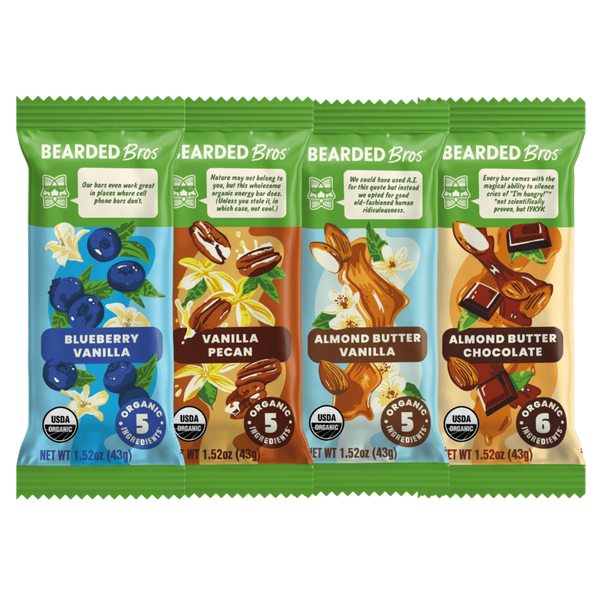
And one that's a recipe decision rather than a certification. We keep the ingredient lists simple, in every flavour and every line. Nothing goes in that does not need to be there.
We also make everything ourselves in Austin. No farming it out, no co-packing, which means the people who wrote this are the same ones running the mixer and arguing about whether the next batch needs more cacao.
Decadent Dark Chocolate, 10-pack
If you want to see what a short ingredient list looks like in practice, this is a good one to start with. Dates doing the sweetening and not much else in the way. See the bar
The rest of the range lives on the energy bars collection page.
Frequently asked questions
How much of a bar has to be organic to carry the USDA seal?
At least 95% by weight, excluding water and salt. A product labeled 100% Organic contains only certified organic ingredients apart from added water and salt, and if processed its processing aids must be organic too. A product labeled "made with organic ingredients" is at least 70% and may not display the USDA seal anywhere on the package, though it can name up to three organic ingredients on the front.
Does organic mean gluten free or vegan?
No. Those are separate certifications with separate bodies behind them. An organic bar can contain wheat, dairy or honey and still be fully certified organic. Gluten free comes from GFCO, vegan from vegan.org, and neither is implied by the USDA seal.
Are organic energy bars worth the extra cost?
That depends on what you want from the purchase. The premium buys a farming standard with inspection and documentation behind it, which is a real thing to buy. If what you're after is protein or a shorter ingredient list, the panel is where to look. Nobody has ever finished a hike wishing they'd checked the paperwork harder.
How can I tell whether the sweetener is whole fruit or syrup?
Look at the first three ingredients. Whole fruit appears under its own name, like dates or figs. Syrups appear as syrups, whatever the source. Ingredients are listed by weight, so the top three are most of the bar.
Does the organic seal mean no preservatives?
Not exactly. Organic standards restrict which preservatives are permitted rather than banning them all. Using none is a recipe decision rather than something the seal guarantees. The ingredient list is where to check.
Does the USDA seal mean the ingredient list is short?
No. Organic is a farming standard and says nothing about how many ingredients a product contains. A certified organic bar can run to twenty items or to five. Ingredient list length is a recipe decision by the maker, and the back of the pack is the only place it is answered.
You already turn the pack over. Here is a range that holds up when you do.
Read our ingredient lists